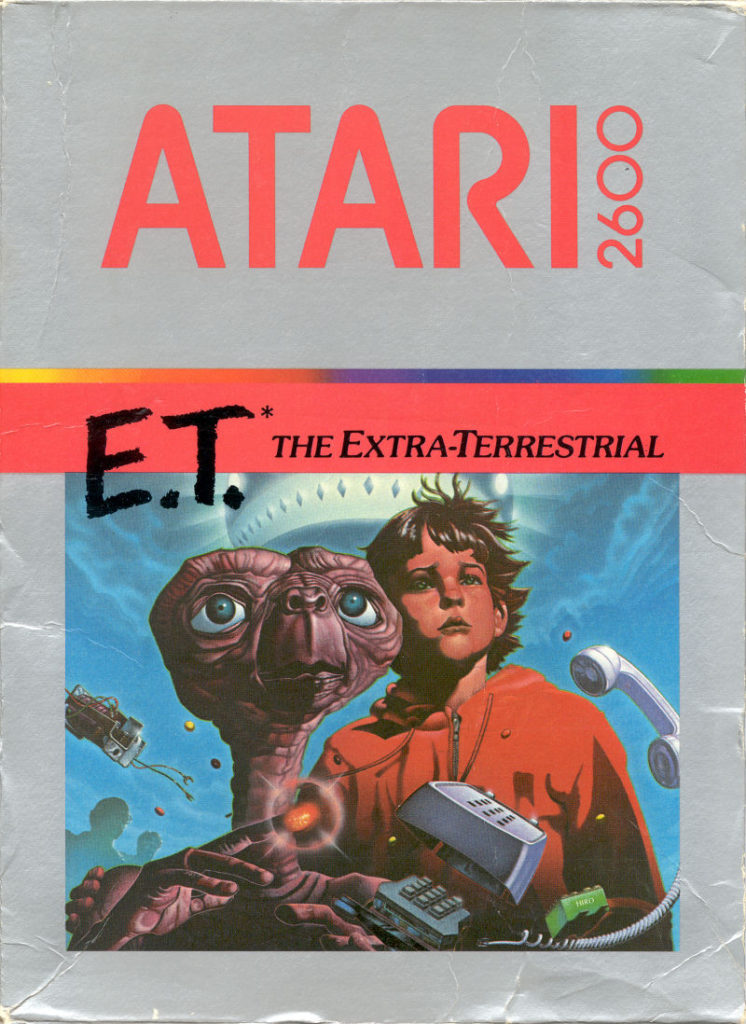
E.T. the Extra-Terrestrial (1982)
E.T. the Extra-Terrestrial received significant criticism for its low-quality graphics and redundant and confusing gameplay.
E.T. the Extra-Terrestrial for the Atari 2600 is based on Steven Spielberg’s 1982 film of the same name, reputedly coded in just five weeks to be released in time for the 1982 holiday season.[22] The game sold 1.5 million copies[23] and came nowhere near Atari’s expectations of five million units.[22] A large number of the cartridges sold were sent back to the company because many consumers found the game to be unenjoyable.[22] Truckloads of these cartridges were buried in a landfill in New Mexico after they failed to sell.[24][25][26] E.T. is commonly cited as the catalyst for a crash of the video game industry in 1983, as Atari had hoped that brand loyalty would help keep consumers buying their games regardless of quality.[26][27]
E.T. was listed as the worst game of all time by PC World in 2006,[3] Electronic Gaming Monthly,[28] and FHM magazine,[29] and was ranked as the second-worst movie game on the “Top Ten Worst Movie Games” (first being Charlie’s Angels) by GameTrailers.[30] It was also ranked the second-worst game of all time by GameTrailers, first-worst went to Superman 64.[4] Some considered it so bad that the title screen was the only good part of the game.[31] In 2007, GamePro named E.T. one of the 52 most important games of all time due to its roles in the 1983 video game crash and the downfall of the seemingly unstoppable Atari. It is the only game to make the list for having a negative impact on the video game industry.[27]
The Atari video game burial was a mass burial of unsold video game cartridges, consoles, and computers in a New Mexico landfill site, undertaken by American video game and home computer company Atari, Inc. in 1983. Up until 2014, the goods buried were rumored to be unsold copies of E.T. the Extra-Terrestrial, one of the biggest commercial failures in video gaming and often cited as one of the worst video games ever released, along with the Atari 2600 port of Pac-Man, which was commercially successful but critically maligned.
Since the burial was first reported in the press, there had been doubts as to its veracity and scope, leading to it being frequently dismissed as an urban legend. In either case the event had become a cultural icon and a reminder of the video game crash of 1983; it was the end result of a disastrous fiscal year which saw Atari, Inc. sold off by its parent company Warner Communications. Though it was believed that millions of copies of E.T. were disposed of in the landfill, Atari officials later verified the numbers to be around 700,000 cartridges of various titles, including E.T.
In 2014, Fuel Industries, Microsoft, and others worked with the New Mexico government to excavate the site to validate the contents of the landfill as part of a documentary called Atari: Game Over. On April 26, 2014, the excavation revealed discarded games and hardware. Only a small fraction, about 1,300 cartridges, were recovered during the excavation period, with a portion given for curation and the rest auctioned to raise money for a museum to commemorate the burial.
Atari video game burial
The Atari video game burial was a mass burial of unsold video game cartridges, consoles, and computers in a New Mexico landfill site, undertaken by American video game and home computer company Atari, Inc. in 1983. Up until 2014, the goods buried were rumored to be unsold copies of E.T. the Extra-Terrestrial, one of the biggest commercial failures in video gaming and often cited as one of the worst video games ever released, along with the Atari 2600 port of Pac-Man, which was commercially successful but critically maligned.
Since the burial was first reported in the press, there had been doubts as to its veracity and scope, leading to it being frequently dismissed as an urban legend. In either case the event had become a cultural icon and a reminder of the video game crash of 1983; it was the end result of a disastrous fiscal year which saw Atari, Inc. sold off by its parent company Warner Communications. Though it was believed that millions of copies of E.T. were disposed of in the landfill, Atari officials later verified the numbers to be around 700,000 cartridges of various titles, including E.T.
In 2014, Fuel Industries, Microsoft, and others worked with the New Mexico government to excavate the site to validate the contents of the landfill as part of a documentary called Atari: Game Over. On April 26, 2014, the excavation revealed discarded games and hardware. Only a small fraction, about 1,300 cartridges, were recovered during the excavation period, with a portion given for curation and the rest auctioned to raise money for a museum to commemorate the burial.
Financial difficulty
Atari, Inc. had been purchased by Warner Communications in 1976 for $28 million, and had seen its net worth grow to $2 billion by 1982.[2][3][4][5] By this time, the company accounted for 80% of the video gaming market;[2] and was responsible for over half of its parent company’s revenues,[6] earning some 65–70% of their operating profits.[2][6] By the last quarter of 1982, its growth in the following year was expected to be in the region of 50%.[2] However, on December 7, 1982, the company reported that its earnings had only increased by 10–15%, rather than the predicted figure.[2] The next day saw Warner Communications’ share prices fall by a third, and the quarter ended with Warner’s profits falling by 56%.[2] In addition, Atari’s CEO, Ray Kassar, was later investigated for possible insider trading charges as a result of selling some five thousand shares in Warner less than half an hour before reporting Atari’s lower-than-expected earnings. Kassar was later cleared of any wrongdoing, although he was forced to resign his position the following July.[7] Atari, Inc. would go on to lose $536 million in 1983, and was sold off by Warner Communications the following year.[2]
Problem titles
Atari’s tendency to port arcade games for its home console had led to some of its most commercially successful games, including the port of its own coin-op Asteroids, and the licensed versions of Taito’s Space Invaders and Namco’s Pac-Man. When the latter game received its official port to the Atari 2600, Atari was confident that sales figures would be high, and manufactured 12 million cartridges—despite having sold only around 10 million Atari 2600 consoles.[2] It was believed that the game would be successful enough not only to earn an estimated $500 million, but also to boost sales of the console itself by several million as gamers sought to play the home conversion.[8][9] However, the finished product, released in March 1982, was critically panned for its poor gameplay,[2] and although it became the console’s best-selling title after shipping 7 million units, it still left Atari with over 5 million unsold cartridges—a problem compounded by the high rate of customers returning the game for refunds.[8][10]
Further to the problems caused by Pac-Man’s underwhelming sales, Atari also faced great difficulty as a result of its video game adaptation of the film E.T. the Extra-Terrestrial. The game, also titled E.T. the Extra-Terrestrial, was a result of a deal between Warner Communications and the film’s director Steven Spielberg, and was an attempt to follow on the success of Atari’s Raiders of the Lost Ark, another film-based game. It was later reported that Warner had paid $20–25 million for the rights, which was at the time quite a high figure for video game licensing.[8] The task of developing the game fell on Howard Scott Warshaw, the programmer for Raiders, but due to lengthy delays in the licensing rights, Warshaw had only five weeks to make a full game to make sure Atari could sell it during the upcoming holiday period.[11] The rushed development resulted in lackluster gameplay, and on release, the game was critically panned, and is now seen as one of the worst ever made.[12][13] Atari manufactured 5 million cartridges for the game;[2] however, upon its release in December 1982, only 1.5 million copies were sold, leaving Atari still holding onto over half of the game cartridges.[14] Billboard magazine’s Earl Paige reported that the large number of unsold E.T the Extra-Terrestrial games, along with an increase in competition, prompted retailers to demand official return programs from video game manufacturers.[15]
The failures of these titles were further compounded by Atari’s business dealings from 1981. Confident in strong sales, the company had told its distributors to place their 1982 orders all at once. However, video game sales in 1982 had slowed, and distributors who had ordered en masse in expectation of high turnover were left to simply return large quantities of unsold stock to Atari. As a result, the company soon found itself in possession of several million essentially useless video game cartridges, which it would be entirely unable to sell.[2]
Burial
The burial is located in the southern part of the city of Alamogordo, New Mexico.
In September 1983, the Alamogordo Daily News of Alamogordo, New Mexico reported in a series of articles, that between 10 and 20[16] semi-trailer truckloads of Atari boxes, cartridges, and systems from an Atari storehouse in El Paso, Texas, were crushed and buried at the landfill within the city. It was Atari’s first dealings with the landfill, which was chosen because no scavenging was allowed and its garbage was crushed and buried nightly. Atari’s stated reason for the burial was that it was changing from Atari 2600 to Atari 5200 games,[17] but this was later contradicted by a worker who claimed that this was not the case.[18] Atari official Bruce Enten stated that Atari was mostly sending broken and returned material to the Alamogordo dump and that it was “by-and-large inoperable stuff.”[16]
On September 27, 1983, the news service UPI reported that “people watching the operation said it included cassettes [sic] of the popular video games E.T., Pac-Man, Ms. Pac-Man, the consoles used to convey the games to television screens and high-priced personal computers.”[19] The news service Knight Ridder further reported on the looting of the dump on September 28 by local kids, stating “kids in this town of 25,000 began robbing the Atari grave, coming up with cartridges of such games as E.T., Raiders of the Lost Ark, Defender, and Berzerk.”[20]
On September 28, 1983, The New York Times reported on the story of Atari’s dumping in New Mexico. An Atari representative confirmed the story for the newspaper, stating that the discarded inventory came from Atari’s plant in El Paso, which was being closed and converted to a recycling facility.[21] The reports noted that the site was guarded to prevent reporters and the public from affirming the contents. The Times article never suggested any of the specific game titles being destroyed, but subsequent reports have generally linked the story of the dumping to the well-known failure of E.T.[2] Additionally, the headline “City to Atari: ‘E.T.’ trash go home” in one edition of the Alamogordo News seems to imply some of the cartridges were E.T., but then follows with a humorous interpretation of E.T. meaning “Extra-territorial” and never specifically mentions the game.[16]
Starting on September 29, 1983, a layer of concrete was poured on top of the crushed materials, a rare occurrence in waste disposal. An anonymous workman’s stated reason for the concrete was: “There are dead animals down there. We wouldn’t want any children to get hurt digging in the dump.”[18] Eventually, the city began to protest the large amount of dumping Atari was doing, with one commissioner stating that the area did not want to become “an industrial waste dump for El Paso.”[16] The local manager ordered the dumping to be ended shortly afterwards. Due to Atari’s unpopular dumping, Alamogordo later passed an Emergency Management Act and created the Emergency Management Task Force to limit the future flexibility of the garbage contractor to secure outside business for the landfill for monetary purposes. Alamogordo’s then-mayor, Henry Pacelli, commented that, “We do not want to see something like this happen again.”[18]
Cultural symbolism and speculation
All of these factors have led to wide speculation that most of the 3.5 million unsold copies of E.T. the Extra-Terrestrial ultimately wound up in this landfill, crushed and encased in concrete.[22] It has also been reported that prototypes for the proposed Atari Mindlink controller system were disposed of at the site,[23] which only further fuels speculation, since Atari Museum owner Curt Vendel actually currently owns the Mindlink prototypes.[24] Writing for the Pacific Historical Review, John Wills speculated that location’s place in the public psyche—its proximity to the sites of both the Trinity nuclear test and Roswell UFO incident—has aided the popularity of the story.[25]
The conflicting information surrounding the burial has led to the claim of it being an “E.T. Dump” being referred to as an urban legend,[26] which in turn has led to a degree of skepticism and doubt over the veracity of the dumping story itself, and the relevance of conflating the event with the later industry downturn.[27][28] As recently as October 2004, Howard Scott Warshaw, the programmer responsible for the E.T. the Extra-Terrestrial game, expressed doubts that the destruction of millions of copies of the game ever took place. Warshaw also believes that Atari’s downfall was more a result of their business practices—including alleged block booking of poorly selling games with successful ones when dealing with distributors—than any specific failed games.[29] This latter view has been echoed by Travis Fahs of IGN, who believes that Atari’s problems, including their huge surplus of unsold stock, arose from the company’s overestimation of the sustainability of Atari 2600 sales, rather than being due to the individual quality of games being released.[30]
The incident has also become something of a cultural symbol representative of the video game crash of 1983, often cited as a cautionary tale about the hubris of poor business practices,[31][32][33] despite suggestions that the burial allowed the company to write off the disposed-of material for tax relief purposes.[32]
In popular culture
The legacy of the burial has led it to be referenced in popular culture. The music video for the song “When I Wake Up” by Wintergreen depicts the band traveling to the landfill site and proceeding to dig up the abandoned cartridges;[34] the video’s director Keith Schofield had worked with video game-based music videos before.[35] The novel Lucky Wander Boy by D.B. Weiss features a scene which takes place outside of Alamogordo, in which two of the characters discuss a parking lot which has been built over the site of the burial.[36] The 2014 film Angry Video Game Nerd: The Movie features a plot centered on the burial.[37] The episode “The Games Underfoot” of the procedural drama Elementary featured a fictional version of the Atari (renamed “Emeryvision”) video game burial.[38]
Excavation
Excavating the landfill. Boxes of Yars’ Revenge, Star Raiders, Pac-Man, Space Invaders, Defender and Warlords can be seen.
Partially-surviving cases and cartridges retrieved during the excavation. E.T., Centipede, and other Atari materials can be seen.
On May 28, 2013, the Alamogordo City Commission granted Fuel Industries, a Canadian entertainment company, six months of access to the landfill to film a documentary called Atari: Game Over about the burial and to excavate the dump site.[39] Xbox Entertainment Studios planned to air this documentary series as an exclusive to the Xbox One and Xbox 360 in 2014 as part of a multi-part documentary series being produced by Lightbox, a US/UK production company.[40] Though the excavation was momentarily stalled due to a complaint by the New Mexico Environmental Protection Division Solid Waste Bureau citing potential hazards, the issues were resolved in early April 2014 to allow the excavation to proceed.[41]
Excavation started on April 26, 2014 as an open event to the public.[42] E. T. the Extra-Terrestrial designer Howard Scott Warshaw, Ready Player One author Ernest Cline and film director Zak Penn attended the event as part of a documentary about the burial,[43] as did local residents such as Armando Ortega, a city official who was reportedly one of the original children to raid the dump in 1983. Ortega stated that although he and his friends found dozens of quality games, they gave the E.T. cartridges away because the “game sucked … you couldn’t finish it”.[44][45] James Heller, the former Atari manager in charge of the original burial, was also on hand at the excavation. Heller revealed that he had originally ordered the site to be covered in concrete. Contrary to the urban legend that claims millions of cartridges were buried there, Heller stated that only 728,000 cartridges were buried.[46]
Remnants of E.T. and other Atari games were discovered in the early hours of the excavation, as reported by Microsoft’s Larry Hyrb.[47][48] A team of archaeologists was present to examine and document the Atari material unearthed by excavation machinery: Andrew Reinhard (American School of Classical Studies at Athens), Richard Rothaus (Trefoil Cultural and Environmental), Bill Caraher (University of North Dakota), with support from video game historian Raiford Guins (Stony Brook University) and historian Bret Weber (University of North Dakota).[49]
Only about 1178[50] cartridges of the estimated 700,000 were removed from the burial, as the remaining materials were deeper than expected, which made them more difficult to access, according to Alamogordo mayor Susie Galea. The burial was refilled following this event.[51] Joseph Lewandowski, who had worked to arrange the unearthing with the city, said that this was a one-time shot to recover materials from the site, as they do not expect the city to agree to a similar event again.[52]
The documentary Atari: Game Over, which features the burial site and its excavation, was released on November 20, 2014.[53][54]
Curation and auction
Of the recovered materials, a fraction has been given to the New Mexico Museum of Space History for display, and another 100 to the documentary producers Lightbox and Fuel Entertainment. Galea believes the remaining cartridges can be sold by the city of Alamogordo through the Museum of Space History. She hopes that the sale of these games can help fund recognition of the burial site as a tourist attraction in the future.[51] The City of Alamogordo approved the auction of the games in September 2014, to be sold through eBay and the Alamogordo Council website. As of September 2015, over $107,000 has been raised through the sales of about 880 unearthed cartridges, with one E.T. copy selling for more than $1,500. About 300 cartridges remain to be sold at a later date given the historical value of the cartridges.[55][56][57][58][52]
One of the E.T. cartridges that had been dug up was taken by the Smithsonian Institution for its records, calling the cartridge both representative of the burial site but also in terms of video games, how the cartridge represents “the ongoing challenge of making a good film to a video game adaptation, the decline of Atari, the end of an era for video game manufacturing, and the video game cartridge life cycle”.[59]
References
- ^ “E.T.™ Needs Your Help! (advertisement)”. Atari Age. Vol. 1 no. 4. The Atari Club Inc. November–December 1982. p. 3. Archived from the original on May 14, 2020. Retrieved May 14,2020.
- ^ Scott, Stilphen. “DP Interviews”. Digitpress.com. Archivedfrom the original on August 31, 2014. Retrieved March 6, 2014.
- ^ Jump up to:a b Goldsmith, Alex (May 30, 2013). “Alamogordo approves Atari excavation”. ALAMOGORDO, N.M.: KRQE. Archived from the original on July 19, 2013. Retrieved May 31, 2013.
- ^ Schreier, Jason. “E.T. Found In New Mexico Landfill”. Kotaku. Archived from the original on February 11, 2015. Retrieved February 4, 2015.
- ^ Jump up to:a b Llorca, Juan Carlos (September 28, 1983). “Diggers Find Atari’s E.T. Games in Landfill”. ABC News. Archived from the original on April 26, 2014. Retrieved April 26, 2014.
- ^ “Diggers find Atari’s E.T. games in landfill”. USA Today. April 26, 2014. Archived from the original on April 27, 2014. Retrieved April 26, 2014.
- ^ Jump up to:a b Poeter, Damon (June 5, 2013). “Debunking the Myth of the Buried Atari E.T. Cartridges”. PCMag UK. Archived from the original on September 6, 2018. Retrieved September 6, 2018.
- ^ Harris, John (November 3, 2017). “Review Roundup: Was E.T. Really the “Worst Game Ever”?”. gamehistory.org. Video Game History Foundation. Retrieved July 16, 2020.
- ^ Jump up to:a b “E.T.* THE EXTRA-TERRESTRIAL manual”. atariage.com. Atari. Retrieved July 16, 2020.
- ^ Jump up to:a b c d Bowen, Kevin. “Game of the Week: E.T. the Extra-Terrestrial”. Classic Gaming. Archived from the original on October 10, 2008. Retrieved August 18, 2014.
- ^ Jump up to:a b “Good Game Shocks the 80s”. Good Game. Series 4. Episode 25. Australian Broadcasting Corporation. October 6, 2008. Event occurs at 3:58. Archived from the original on October 8, 2009. Good Game Stories – Game Review: E.T. the Extra-Terrestrial. Retrieved September 21, 2009.
- ^ “Atari Gets ‘E.T.’ Rights”. The New York Times. August 19, 1982. p. D6. Archived from the original on May 14, 2020.
- ^ Jump up to:a b c d Harmetz, Aljean (January 15, 1983). “New Faces, More Profits For Video Games”. Times-Union. p. 16. Archived from the original on August 1, 2019. Retrieved February 28, 2012.
- ^ Jump up to:a b c d Keith, Phipps (February 2, 2005). “Howard Scott Warshaw”. A.V. Club. Archived from the original on June 5, 2011. Retrieved September 24, 2009.
- ^ Jump up to:a b c d e f Kent, Steven L. (2001). The Ultimate History of Video Games. Roseville, California: Prima. pp. 237–239. ISBN 0-7615-3643-4.
- ^ Jump up to:a b c “E.T. Starring in Sales of Toys”. The New York Times. December 13, 1982. pp. D1, D8. Archived from the original on May 14, 2020.
- ^ Jump up to:a b c From The Washington Post (January 14, 1986). “Many Video Games Designers Travel Rags-to-Riches-to-Rags Journey”. Los Angeles Times. Archived from the original on May 14, 2020.
- ^ Jump up to:a b c d Bowen, Kevin. “ClassicGaming Expo 2000: Atari 2600 Keynote”. GameSpy. Archived from the original on January 9, 2014. Retrieved September 28, 2009.
- ^ Jump up to:a b c d e f g Stilphen, Scott. “DP Interviews: Howard Scott Warshaw”. Digital Press: The Video Game Database. Retrieved July 16, 2020.
- ^ “The Crash”. G4 Icons. Season 2. Episode 14. G4techTV. Archived from the original on December 27, 2015. Retrieved August 18, 2014.
- ^ Jump up to:a b Warshaw, Howard Scott. “Two questions I face constantly are…” onceuponatari.com. Retrieved July 17, 2020.
- ^ Brumfiel, Geoff (May 31, 2017). “Total Failure: The World’s Worst Video Game”. NPR. Archived from the original on May 14, 2020. Retrieved May 9, 2020.
- ^ Jump up to:a b Hooper, Richard (February 22, 2016). “The man who made ‘the worst video game in history'”. BBC. Retrieved July 17, 2020.
- ^ Cummings, Betsy (December 2003). “How I got here”. Sales and Marketing Management.[volume & issue needed]
- ^ Jump up to:a b Pollack, Andrew (December 19, 1982). “The Game Turns Serious at Atari”. The New York Times. p. F1. Archived from the original on May 15, 2020.
- ^ Jump up to:a b c d Buchanan, Levi (August 26, 2008). “IGN: Top 10 Best-Selling Atari 2600 Games”. IGN. Archived from the original on July 26, 2011. Retrieved September 21, 2009.
- ^ “A Squeeze in Video Games”. The New York Times. December 7, 1982. pp. D1, D5. Archived from the original on May 14, 2020.
- ^ Cohen, Scott (1984). Zap! The Rise and Fall of Atari. McGraw Hill Book Company. ISBN 0-07-011543-5.[page needed]
- ^ Jump up to:a b Pileggi, Nicholas (January 24, 1983). “The Warner Case: Curiouser and Curioser”. New York. Vol. 16 no. 4. New York Media, LLC. pp. 26–32. ISSN 0028-7369.
- ^ Jump up to:a b Hubner, John; William F. Kistner Jr. (December 5, 1983). “What went wrong at Atari”. InfoWorld. Vol. 5 no. 49. pp. 145–155. ISSN 0199-6649.
- ^ “Billboard Top 15 Video Games”. Billboard. Vol. 95 no. 1. Nielsen Business Media, Inc. January 8, 1983. p. 36. ISSN 0006-2510.
- ^ Jump up to:a b Glenday, Craig, ed. (2009). “History of Gaming: 1980–1993”. Guinness World Records 2009 Gamer’s Edition. Guinness World Records. p. 20. ISBN 978-1-904994-45-9.
- ^ Cartridge Sales Since 1980. Atari Corp. Via “The Agony & The Ecstasy”. Once Upon Atari. Episode 4. Scott West Productions. August 10, 2003. 23 minutes in.
- ^ Jump up to:a b c “Five Million E.T. Pieces”. Snopes. Retrieved July 1, 2006.
- ^ Bruck, Connie (1995). Master of the Game: Steve Ross and the Creation of Time Warner. Penguin Books. pp. 179–180. ISBN 0-14-024454-9.
- ^ “ET: The Extra 200,000 Cartridges?”. Next Generation. No. 26. Imagine Media. February 1997. p. 43. ISSN 1078-9693.
- ^ Ellis, David (2004). Official Price Guide to Classic Video Games. Random House. p. 85. ISBN 0-375-72038-3.
- ^ Wiswell, Phil (March 1983). “New Games From Well-Known Names”. Video Games. p. 69. Archived from the original on July 5, 2015. Retrieved May 26, 2014.
- ^ “The Best and the Rest”. St.Game (Softline). Vol. 3 no. 3. March–April 1984. p. 49. ISSN 0745-4988. Archived from the original on July 29, 2014. Retrieved July 28, 2014.
- ^ Vogt, Rick (March 5, 1983). “E.T. Game is Extra-Tough But Worth The Effort”. The Miami Herald. p. 3C.
- ^ Christopher, Kevin (February–March 1983). “ET Phones Home for the Holidays”. Vidiot. Vol. 1 no. 2. pp. 41–43. Archived from the original on March 16, 2016. Retrieved May 31, 2015.
- ^ “E.T./Videogame Cartridge (for Atari VCS)/Atari” (PDF). Arcade Express. Vol. 1 no. 10. December 19, 1982. p. 7. ISSN 0733-6039. Archived (PDF) from the original on October 6, 2016. Retrieved October 18, 2017.
- ^ Jump up to:a b c d Townsend, Emru (October 23, 2006). “The 10 Worst Games of All Time”. PC World. Archived from the original on September 6, 2011. Retrieved January 24, 2007.
- ^ Jump up to:a b c Reiley, Sean. “Seanbaby’s EGM’s Crapstravaganza: The 20 Worst Video Games of All Time. – #1: ET, The Extra Terrestrial (2600)”. Electronic Gaming Monthly. Archived from the original on January 27, 2017. Retrieved March 4, 2017.
- ^ Next Generation Staff (April 1998). “What the hell happened?”. Next Generation. Vol. 4 no. 40. Imagine Media. p. 47. ISSN 1078-9693.
- ^ Terdiman, Daniel (April 26, 2014). “Success! Atari E.T. games found in New Mexico dump”. CNET. Archived from the original on April 27, 2014. Retrieved April 27, 2014.
- ^ Llorca, Juan Carlos (April 26, 2014). “Diggers begin quest to unearth Atari’s E.T. games”. The State Journal. Associated Press. Archived from the original on April 27, 2014. Retrieved April 27,2014.
- ^ Jump up to:a b “ClassicGaming.com’s Museum: Five Must-See 2600 Games”. GameSpy. Archived from the original on October 5, 2008. Retrieved September 25, 2009.
- ^ “History of Gaming: The Best and Worst Video Games of All Time”. Public Broadcasting Service. Archived from the original on November 3, 2011. Retrieved September 25, 2009.
- ^ Jump up to:a b “GT Countdown: Top Ten Best and Worst Games of All Time”. GameTrailers. November 17, 2006. Archived from the original on January 28, 2011. Retrieved September 25, 2009.
- ^ Elektro, Dan (August 8, 2003). “Secrets & Lies”. GamePro. Archived from the original on June 7, 2011. Retrieved September 29, 2009.
- ^ Jump up to:a b Montfort, Nick; Bogost, Ian (2009). Racing the Beam: The Atari Video Computer System. MIT Press. p. 127. ISBN 978-0-262-01257-7.
- ^ Montfort, Nick; Bogost, Ian (2009). Racing the Beam: The Atari Video Computer System. MIT Press. p. 94. ISBN 978-0-262-01257-7.
- ^ “The 52 Most Important Video Games of All Time”. GamePro. April 25, 2007. Archived from the original on September 12, 2008. Retrieved September 27, 2009.
- ^ Parish, Jeremy. “The Most Important Games Ever Made: #13: E.T.” 1UP.com. Archived from the original on May 24, 2012. Retrieved July 1, 2006.
- ^ Glenday, Craig, ed. (2009). “Movies & Games Round-Up”. Guinness World Records 2009 Gamer’s Edition. Guinness World Records. p. 184. ISBN 978-1-904994-45-9.
- ^ Jump up to:a b Smithee, Alan (July 1, 2004). “10 to 1: The Worst Movie Games Ever”. GamePro. Archived from the original on May 25, 2010. Retrieved September 28, 2009.
- ^ Jump up to:a b Morris, Dave (2004). The Art of Game Worlds. HarperCollins. p. 126. ISBN 0-06-072430-7.
- ^ “20 Games that Changed the World”. GamePro. April 4, 2006. Archived from the original on January 11, 2010. Retrieved September 28, 2009.
- ^ Dvorak, John C (August 12, 1985). “Is the PCJr Doomed To Be Landfill?”. InfoWorld. Vol. 7 no. 32. p. 64. ISSN 0199-6649. Archived from the original on August 1, 2019. Retrieved September 10, 2011.
- ^ Jary, Simon (August 19, 2011). “HP TouchPads to be dumped in landfill?”. PC Advisor. Archived from the original on November 8, 2011. Retrieved September 10, 2011.
- ^ Kennedy, James (August 20, 2011). “Book Review: Super Mario”. The Wall Street Journal. Archived from the original on September 6, 2017. Retrieved September 10, 2011.
- ^ Paige, Earl (January 8, 1983). “Video Game Firms Ready Formal Returns Policies”. Billboard. Vol. 95 no. 1. Nielsen Business Media, Inc. pp. 1, 21. ISSN 0006-2510.
- ^ “ClassicGaming.com’s Museum: Atari 2600 – 1977-1984”. GameSpy. Archived from the original on June 11, 2009. Retrieved September 25, 2009.
- ^ Montfort, Nick; Bogost, Ian (2009). Racing the Beam: The Atari Video Computer System. MIT Press. p. 76. ISBN 978-0-262-01257-7.
- ^ Jump up to:a b c “This Month in Gaming History”. Game Informer. No. 140. GameStop. December 2004. p. 202.
- ^ Taylor, Alexander L.; Thompson, Dick; Washburn, Susanne (December 20, 1982). “Pac-Man Finally Meets His Match”. Time. Vol. 120. p. 62. Archived from the original on November 4, 2012. Retrieved September 30, 2009.
- ^ Quote: “The number of actual trucks which have dumped locally was not known. Local BFI officials put it at 10. However, corporate spokesmen in Houston say it was closer to 20; and city officials say it is actually 14.”
McQuiddy, “City cementing ban on dumping.” - ^ “Atari Parts Are Dumped”. The New York Times. September 28, 1983. p. D4. Archived from the original on May 15, 2020.
- ^ McQuiddy, “Dump here utilized.”
- ^ McQuiddy, “City cementing ban on dumping.”
- ^ McQuiddy, “City to Atari.”
- ^ Smith, “Raising Alamogordo’s legendary Atari ‘Titanic'”
- ^ Hilliard, Kyle (April 26, 2014). “E.T. Atari Cartridge Landfill Excavation Uncovers Fabled Cache”. Game Informer. Archivedfrom the original on April 27, 2014. Retrieved April 26, 2014.
- ^ Truitt, Brian. (September 2, 2014). “‘Angry Video Game Nerd’ tackles Atari cartridge legend”. USA Today. USA Today
- ^ Lowe, Justin. (5:11 PM PDT July 25, 2014). “‘Angry Video Game Nerd’: Fantasia Review”. The Hollywood Reporter
- ^ Robarge, Drew (December 15, 2014). “From landfill to Smithsonian collections: “E.T. the Extra-Terrestrial” Atari 2600 game”. Smithsonian Institution. Archived from the original on December 18, 2014. Retrieved December 17, 2014.
- ^ “The Worst Video Game Ever?”. Sidedoor (Podcast). Season 4. Episode 2. Smithsonian Institution. June 26, 2019. 23 minutes in. Archived from the original on May 15, 2020. PDF transcript(PDF).
- ^ “Unearthing the Atari Tomb: How E.T. Found a Home at The Henry Ford”. The Henry Ford Blog. Archived from the original on February 24, 2016. Retrieved January 14, 2016.
- ^ “Digital Collections – Atari Video Game Burial, 1983”. The Henry Ford. Retrieved May 14, 2020.
- ^ “E.T. – The Extra-Terrestrial (Alamogordo Atari Dig)”. computinghistory.org.uk. Retrieved February 3, 2021.
- ^ Jump up to:a b Johnson, Phil (May 6, 2014). “Digging up E.T.’s source code”. ITworld. Archived from the original on September 2, 2018. Retrieved September 6, 2018.
- ^ Cocilova, Alex (April 16, 2013). “How hacking fixed the worst video game of all time”. PCWorld. Archived from the original on May 8, 2019. Retrieved September 11, 2018.
Bibliography
Periodicals
- McQuiddy, Marian E. (September 25, 1983). “Tons of Atari Games Buried; Dump here utilized”. Alamogordo Daily News. p. 1. Archived 2005-04-01.
- McQuiddy, Marian E. (September 27, 1983). “City to Atari: ‘E.T.’ trash go home”. Alamogordo Daily News.Archived 2005-04-01.
- McQuiddy, Marian E. (September 28, 1983). “City cementing ban on dumping: Landfill won’t house any more ‘Atari rejects'”. Alamogordo Daily News.